AI STRATEGY
Building AI is easy. Scaling it into a reliable, revenue-generating product is where most teams struggle.

AI STRATEGY
Building AI is easy. Scaling it into a reliable, revenue-generating product is where most teams struggle.
Artificial Intelligence has moved from hype to execution. Organizations across industries are investing heavily in AI to improve efficiency, enhance customer experiences, and unlock new revenue streams.
Yet, despite this surge in adoption, a significant percentage of AI initiatives never make it to production.
The problem isn’t innovation—it’s execution.
This blog explores why AI projects fail during the transition from prototype to production and how organizations can build a sustainable AI strategy that delivers real business value.
AI prototypes are designed to prove a concept. They are fast, flexible, and built in controlled environments. Data is clean, systems are isolated, and performance metrics are optimized.
In this phase, success is easy to demonstrate.
However, prototypes do not account for real-world complexity. They are not built for scale, reliability, or integration. This creates a dangerous gap between what works in a demo and what works in production.
Many teams mistake a successful prototype for a production-ready solution.
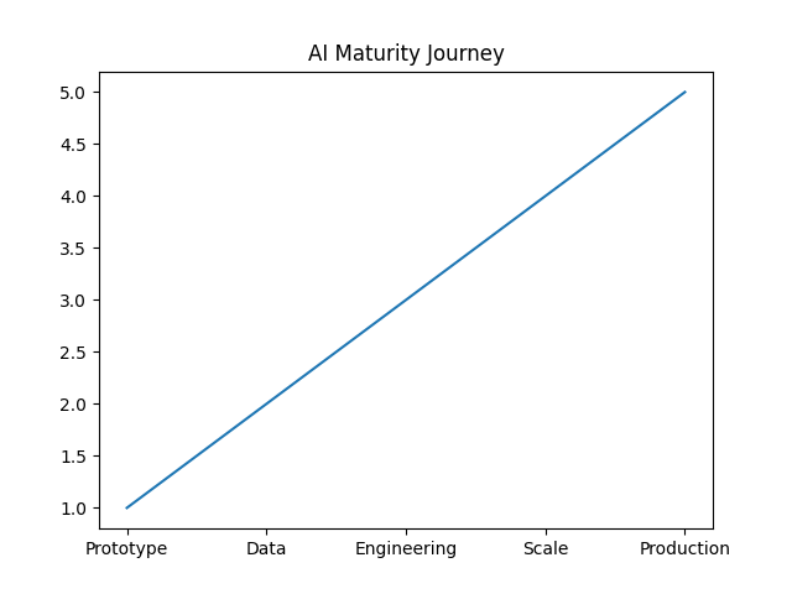
The gap between prototype and production isn’t just technical—it involves data pipelines, system design, monitoring, scalability, and business alignment. Moving to production requires robust infrastructure, reliable workflows, and continuous performance tracking. Success comes from aligning engineering efforts with real-world business goals and long-term scalability.
This shift introduces complexity that most teams underestimate.
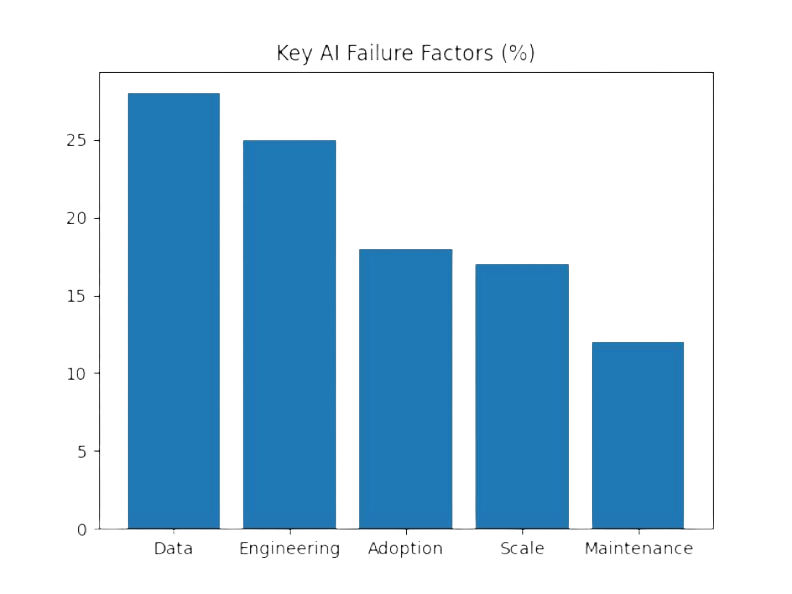
Data is fragmented, inconsistent, and constantly evolving. Without strong pipelines and governance, AI loses accuracy.
Data drift further reduces model effectiveness over time. Successful organizations treat data as a strategic asset.
Poor data quality is the fastest way to break even the best AI systems.
Without alignment, AI projects fail to sustain support.
AI success is not about models—it’s about integrating systems, aligning with business, and designing for real-world complexity.
The most common failure is not technical—it’s strategic.
Teams must build for production realities from day one—not just focus on prototypes.
A model alone has no value—it must operate reliably at scale.
Latency, throughput, and reliability define production success.
Architecture must be designed for scale from the beginning—not later.
AI requires continuous monitoring, retraining, and updates. It is never a one-time deployment.
The journey from prototype to production defines true AI success.
Most failures are not due to weak models, but due to systems not built for real-world complexity.
Building AI is easy. Scaling it into a reliable, revenue-generating product requires strategy, discipline, and execution.